
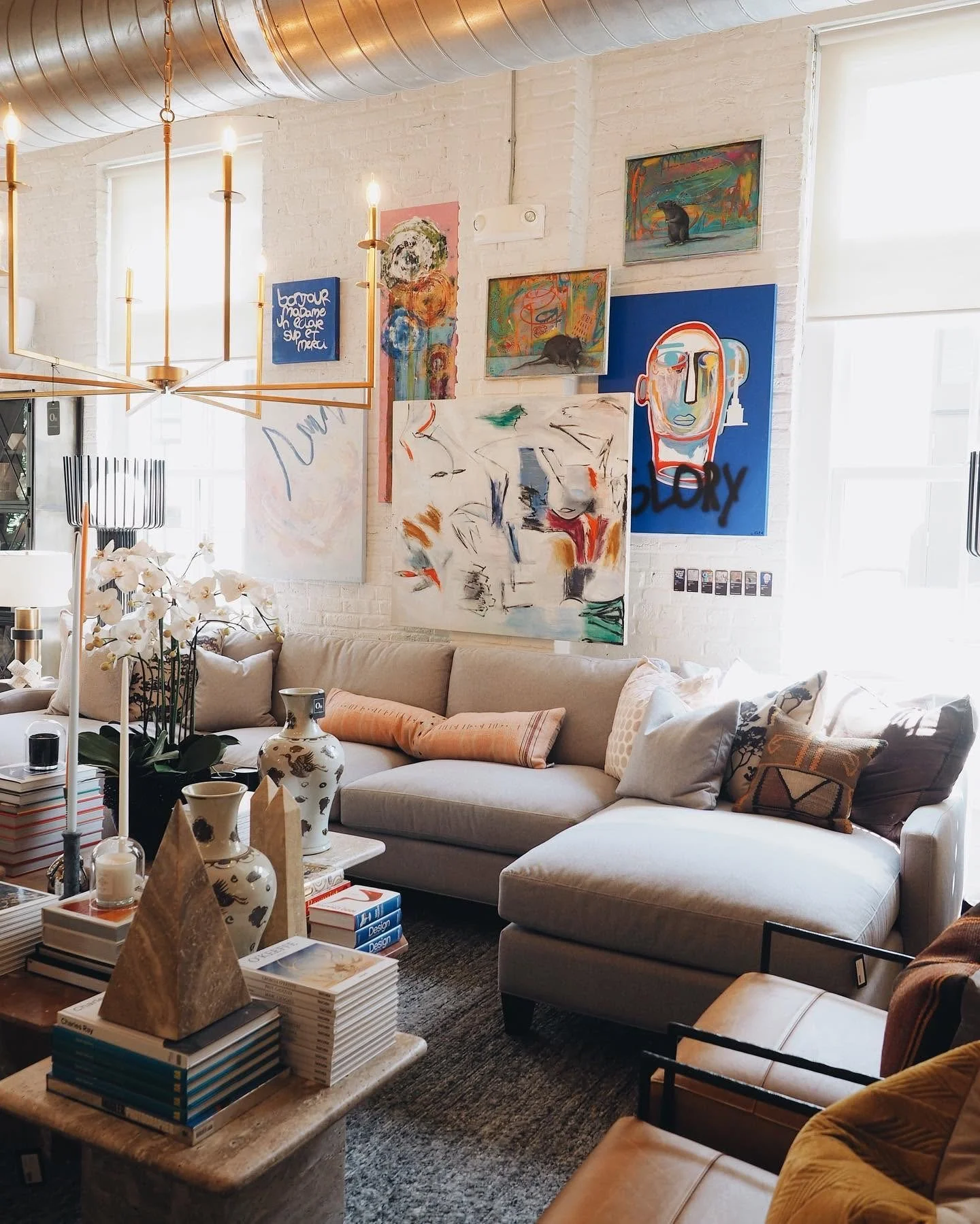
How Do You Arrange Different Pieces of Original Art on the Same Wall?
You don't need matching frames, identical colors, or artwork from the same artist to create a beautiful gallery wall. The key is to treat the pieces as one composition, balancing their sizes, visual weight, and spacing while allowing each work to maintain its own character.
Start with a piece that naturally draws your attention, arrange the others around it, and experiment with the layout before hanging anything. A collection of original paintings, photography, and mixed-media artwork can feel cohesive even when the pieces are completely different.
The most interesting arrangements often come from artwork collected at different times. The goal is to create a display that feels intentional without losing the personality of each piece.
Start With the Artwork You Already Own
Before deciding on a gallery wall layout, gather the pieces you're considering and look at them together.
You might have a colorful abstract painting, a framed black-and-white photograph, a small landscape, and a textured mixed-media piece. Their subjects and dimensions may have little in common, but that doesn't mean they can't share a wall.
Lay everything out where you can see it clearly. Notice which pieces naturally attract your attention and which feel quieter.
Find Your Anchor Piece
An anchor piece gives the arrangement a starting point. It might be the largest painting, but it could also be a smaller work with strong colors, an unusual shape, or a striking subject.
In our example, the abstract painting might immediately catch your eye because of its bold colors. The larger photograph may actually feel quieter because of its softer contrast.
Start with whichever piece feels visually strongest. The remaining works can help balance it.
If you're still deciding which pieces belong in your collection, our guide to choosing original art for your home explores artwork selection in greater detail.
Choose a Layout That Fits Your Collection
There isn't one correct way to arrange different sizes of art on a wall. The best layout depends on the artwork itself, the available space, and the feeling you want to create.
Structured Arrangements
A structured gallery wall follows an organized grid or repeated alignment.
This approach can work well with artwork of similar dimensions, such as a series of photographs or small paintings.
The pieces don't necessarily need identical frames, but consistent spacing and aligned edges help establish order.
Asymmetrical and Collected Arrangements
An asymmetrical gallery wall combines different sizes and orientations without following a rigid grid. This is often a natural choice for original artwork collected over time.
Imagine placing our colorful abstract painting slightly off-center. The larger photograph could sit opposite it, with the small landscape and mixed-media work filling the spaces between.
The arrangement doesn't have to be symmetrical to feel balanced. You can vary the spacing and alignment as long as the pieces still read as one composition.
This approach also leaves room for unusual shapes, different framing styles, and artwork that doesn't fit neatly into a traditional grid.
How Do You Balance Different Sizes and Styles?
Balance comes from distributing visual weight across the arrangement, not simply placing equal-sized artwork on opposite sides.
Visual weight describes how strongly a piece attracts attention. Size contributes to it, but so do color, contrast, subject matter, frame thickness, and texture.
Think Beyond the Size of the Frame
Return to our four pieces: the abstract painting, black-and-white photograph, small landscape, and mixed-media artwork.
The abstract painting may be the strongest visual element, even if the photograph is larger.
Rather than placing the abstract painting directly in the center, you could position it to one side and balance it with the photograph and smaller works opposite it.
Step back and look at the grouping as a whole. Does your eye move comfortably between the pieces, or does one area seem to demand all the attention?
If the abstract painting dominates, try moving the photograph closer to it or shifting the smaller works to create a stronger counterbalance.
Find Connections Without Forcing a Match
Artwork can relate through subtle details.
A dark frame might echo a dark area in a neighboring painting. The curved shapes in an abstract work might complement the organic forms in a landscape. Two completely different pieces may share a similar mood.
These relationships help a collection feel connected without making it predictable.
You don't need to find a common feature in every piece. Sometimes the contrast is what makes the arrangement interesting.
Leave Room for Each Piece to Breathe
Negative space, the open wall surrounding the artwork, is part of the composition.
If every available inch is filled, individual pieces can lose their impact.
A little breathing room allows viewers to appreciate each work while still experiencing the collection as a whole.
Mixing Frames, Materials, and Mediums
Different frame styles can work together beautifully, especially when the artwork itself is varied.
A traditional gilded frame might sit beside a simple black frame or an unframed canvas. The contrast can add character rather than create a problem.
If the arrangement feels disconnected, look for a small amount of repetition. Perhaps two frames share a similar wood tone, or several pieces have comparable proportions.
There's no need to replace perfectly good frames simply to create a matching set.
Can Paintings and Photography Hang Together?
Absolutely. Original paintings, photography, and works on paper can share a wall.
The important consideration is how their scale, contrast, and framing relate.
A photograph with generous matting may have a quieter presence than a colorful painting of the same overall dimensions. Consider those differences when deciding where each piece belongs.
The same principle applies to the rest of your home. A traditional painting doesn't require traditional furniture, just as contemporary artwork doesn't have to hang in a completely modern room. Contrast between different periods and styles can make an interior feel more personal.
What About Three-Dimensional Artwork?
Wall-mounted ceramics, relief sculpture, and other dimensional works can add depth to an arrangement.
However, their projection from the wall, weight, and mounting requirements deserve special attention.
Some pieces need specialized installation or additional clearance. Don't assume hardware intended for framed pictures will support dimensional artwork.
Spacing, Height, and the Surrounding Room
Spacing should make the artwork feel connected without crowding it.
For many gallery walls, approximately two to three inches between frames can be a useful starting point. However, this isn't a universal rule.
Smaller pieces may look better closer together, while substantial frames or dimensional artwork may need more room.
The relationship between pieces matters more than following one measurement everywhere.
How High Should a Gallery Wall Hang?
Think of the entire grouping as one composition rather than hanging each artwork independently at eye level.
For an arrangement on an open wall, consider where people will typically view it. A collection in a hallway may be experienced mostly while standing, while artwork in a living room may be viewed from seated positions.
Above a sofa or console, the furniture becomes part of the composition. Position the grouping so it feels connected to what's beneath it without appearing crowded.
Consider the arrangement's total width, too. A small cluster can look lost above a substantial sofa, while an overly wide grouping may overwhelm a narrow console.
Artwork doesn't exist separately from the rest of the room. The shape of a console, the scale of a lamp, or the texture of nearby furnishings can influence how a collection feels.
At Obelisk, we appreciate how artwork and furnishings influence one another. If you're considering changes beyond the artwork itself, you can explore furniture and home décor in our showroom for ideas.
For rooms where those relationships are particularly challenging, our interior design services can help bring the different elements together.
Plan the Arrangement Before Hanging
You can avoid unnecessary holes and frustrating adjustments by testing the layout before installing anything.
Here's a practical approach.
Step 1: Measure the Artwork
Record each piece's outside dimensions, including its frame.
Also measure the available wall space and note nearby furniture, switches, vents, or architectural features.
Step 2: Arrange Everything on the Floor
Lay the artwork on a clean, protected surface.
Begin with your anchor piece and move the remaining works around it.
Experiment with different arrangements. Try moving smaller pieces closer together or shifting the strongest work away from the center.
Take photographs of layouts you like so you can compare them.
Step 3: Check the Overall Composition
Look at the arrangement from a distance.
Does one side feel heavier? Are the gaps creating awkward empty areas? Does the grouping feel like one collection or several unrelated clusters?
Make adjustments before moving to the wall.
Step 4: Create Paper Templates
Trace each frame onto paper, cut out the shapes, and label them.
Temporarily attach the templates to the wall using a method appropriate for the wall finish.
This lets you evaluate the arrangement at its actual height and in relation to nearby furniture.
Step 5: Mark Hanging Points and Install Carefully
Check the location of each artwork's hanging hardware. The attachment point may sit below the frame's top edge, so don't assume the nail belongs at the top of your paper template.
Use hardware appropriate for the artwork's weight, hanging system, and wall construction.
Heavy, valuable, unusually shaped, or fragile works may require professional installation. Avoid relying on adhesive strips unless the product is specifically suitable for the artwork and mounting conditions.
Protect the Artwork
Consider the environment before choosing the final location.
Direct sunlight can fade or damage certain pigments, photographs, and works on paper. Excessive heat, moisture, and fluctuating humidity may also affect sensitive materials.
Keep vulnerable artwork away from harsh sunlight, heat sources, and damp areas. If a piece has unusual materials or conservation needs, seek guidance from a qualified art professional.
When the Arrangement Doesn't Look Right
Sometimes an arrangement looks promising on the floor but feels different once it's on the wall.
Before starting over, identify what's bothering you.
| What you're noticing | What to try |
|---|---|
| The wall feels crowded | Increase spacing or temporarily remove a piece |
| One artwork dominates everything | Shift its position or balance it with a grouping of smaller works |
| The pieces feel disconnected | Look for a repeated color, shape, frame finish, or visual rhythm |
| One side feels too heavy | Redistribute pieces based on visual weight rather than size alone |
| The arrangement feels scattered | Bring related pieces closer together or establish a clearer overall shape |
| The grouping feels disconnected from the furniture | Reconsider its width, height, and position above the furniture |
Don't assume the artwork itself is the problem. Often, changing the spacing or moving one piece is enough to improve the composition.
Frequently Asked Questions
Can I add another piece to an existing gallery wall later?
Yes. A gallery wall can evolve as your collection grows. Before adding something new, consider whether it balances the existing pieces or whether a small rearrangement would create a better composition.
Does a gallery wall need an odd number of artworks?
No. Odd numbers can create interesting arrangements, but even-numbered collections can work just as well. Focus on the relationship between the pieces rather than following a numerical rule.
Should I reframe older artwork to match newer pieces?
Not necessarily. Different frames can contribute to a collected appearance. If an older work has a historically significant or delicate frame, consult a qualified framing or conservation professional before changing it.
Can I arrange artwork around a doorway or light switch?
Yes, although architectural features should influence the layout. Maintain practical access to switches and avoid placing artwork where doors, furniture, or everyday movement could damage it.
Should I leave space for artwork I might purchase later?
You can, but you don't need to leave an obvious gap. Create an arrangement that feels complete now, knowing you can adjust it as your collection grows.
Build a Collection That Feels Like Your Own
A meaningful art collection doesn't have to be assembled all at once. A painting discovered years ago, a photograph that caught your attention, and a newer piece from a local artist can all belong together.
At Obelisk, we enjoy bringing original artwork into spaces where it can be experienced alongside furniture, lighting, and other design elements. Our multi-level gallery and showroom in downtown Springfield, Missouri, offer opportunities to explore different artistic styles, materials, and perspectives in person.
If you're looking for another piece to complete your arrangement, bring a few photos of your wall and the artwork you already own when you visit. They'll give us a helpful starting point for talking about scale, color, and what might work alongside your collection.
You don't need a perfectly planned collection or a full interior design project to visit.
Explore original artwork at Obelisk Gallery and discover pieces that might become part of your home's evolving story.